
How to Make Preserved Lemons
Preserved lemons are wonderful to have in your kitchen. If you grow your own lemons, you can enjoy them preserved all year long. As a condiment they add bright citrus flavor to countless dishes.

How long does it take to preserve lemons?
This recipe is easy to make, but it does take a little patience. Don’t expect to enjoy your preserved lemons the next day. It takes 3 to 4 weeks in the refrigerator before the lemons are just right for using.
What do preserved lemons taste like?
It’s crazy to think you eat the entire fruit — the lemon peel, rind, and everything — of these lemons, but that’s the magic of preserving. As the salt and lemon juices combine and soften the lemon rind, you get a mellow, bright flavor that works so well with many proteins and vegetables.
What lemons are good for preserving?
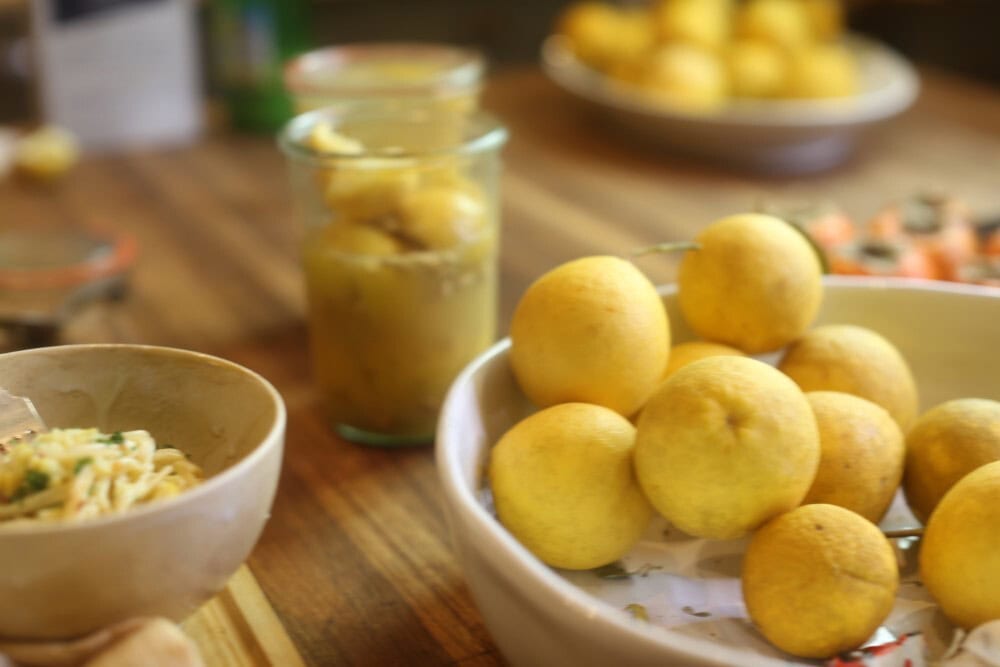
I love Meyer lemons for this recipe. They are bright and juicy, and their skins are smooth and shiny. The skins are also a bit thinner and less bitter than those of other lemons.
Meyer lemons are so purely lemon, but along with the tartness, they are a little sweet.

How to make preserved lemons
Follow the steps below, and in a few weeks, you’ll have perfectly preserved lemons.
Scrub and then cut the lemons.
First, clean 8 large lemons very well by scrubbing them under running water.
Trim the lemons on the top and bottom by cutting about 1/4 inch off each end. Then stand the lemons flat on a clean cutting board. Keeping the lemons pressed against the cutting board at the bottom end, cut each lemon into quarters part-way through.
No need to remove the seeds! You don’t want to lose any liquid from the lemons, and the seeds will come out when you go to serve them after preserving.
Soak the lemons in kosher salt and sugar and refrigerate for 1 day.
Transfer the lemons to a large bowl. Mix 1/2 cup of kosher salt and 2 tablespoons of sugar. Open up the lemons at the top and stuff each with plenty of the salt and sugar mixture. Then roll the lemons around in whatever remains of the salt and sugar. Cover the bowl with plastic wrap and refrigerate overnight or for up to 24 hours.
Transfer to a sterilized canning jar and add peppercorns, bay leaf, and lemon juice.
The following day, the lemons will have released some juice. Transfer the salted lemons and their juices to a large, sterilized canning jar. Press the lemons down firmly into the jar.
Add a couple tablespoons of peppercorns and a few dry bay leaves. Add fresh lemon juice to fill the jar and cover the lemons—you’ll need the juice of 8 regular lemons (not Meyer), or 2 1/2 cups of fresh lemon juice. Be sure to submerge the lemons so that the lemon juice covers the very top.
Seal the jar and refrigerate for 1 month.
Now, cover the jar with a tight-fitting lid and refrigerate for 3-4 weeks before consuming. The lemons will soften and mellow as they sit in the pickling liquid.
Salt-preserved lemons will keep in the fridge for up to 6 months.

Uses of Preserved Lemons
The uses of preserved lemons are endless!
Whip up a gremolata, add them to pasta with a good olive oil, or bake chicken with them. In Moroccon cooking, preserved lemons are a key ingredient of a chicken tagine.
Your preserved lemons are absolutely perfect for homemade vinaigrettes. There’s not a better base.
Add brightness to stews and soups like Moroccan Venison Stew, Mexican Chicken Soup, and Lentil Soup.
Add as a chutney over vegetables like collards and black-eyed peas.
They are perfect over roasted chicken, spatchcocked chicken and turkey, and fish such as salmon, snapper, and flounder.
You can add the preserved lemon juice to drinks, too. Many folks like the juice in gin on the rocks.

Preserved Lemons
Ingredients
- 8 large lemons
- ¾ cup of kosher salt coarse salt
- 4 dry bay leaves
- Juice of 8 regular lemons not Meyer, about 3 cups
Instructions
- Cut lemons into quarters, keeping them attached at the ends. Rub the entire flesh with salt and pack them into a wide-mouth mason jar, or other jar with a tight lid. As you add the lemons, add a little more salt between the layers. Pour the lemon juice over the top of the lemons, ensuring they are all covered. Add the lid and store in the refrigerator.
- When you are ready to use the preserved lemons, usually you will need to rinse them and remove the pulp. Often I don’t have to rinse the lemons and can use the flesh as well if they taste OK. Give them a taste and you be the judge of that.